
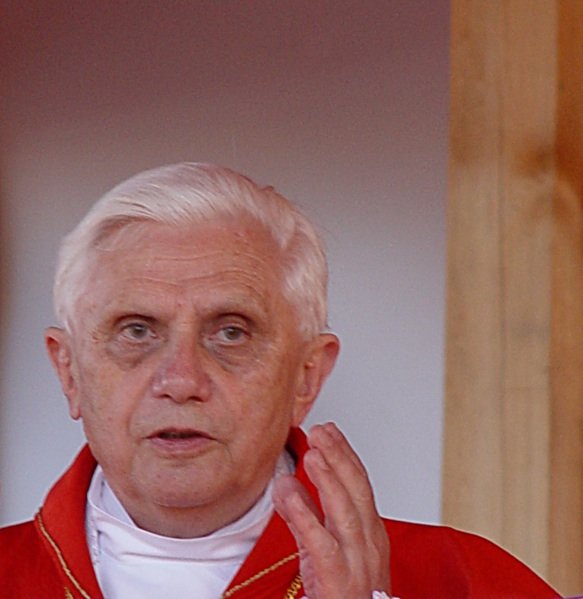
I was attending the Evensong service at Westminster Abbey on February 11th when I first heard the news that Pope Benedict XVI announced an early retirement from the papacy.
My immediate reaction was a mixture of curiosity and embarrassment. I was curious to know what led Pope Benedict to become the first pope in 600 years to retire, but even more than that, I felt a little embarrassed that I did not know that the Pope had made this decision. Only moments after I spoke the words of the Apostle’s Creed and the Lord’s Prayer in union with many Christians across the world, past, present, and future, I felt drastically out of touch with present-day Christians in the rest of the world.
Granted, I did not know of the news because my wife and I had just gotten off a red-eye from Vancouver to London, England only a few hours prior to our stop at Westminster Abbey, but the detachment was enough to cause me pause – especially considering I was on my way to live in rural Uganda for the next year.
News is shaped by communities large and small, but it seems, as with most things these days, that the large communities eventually win out over the small communities. With the increasing availability of mobile phone networks and the Internet, small communities no longer have to depend on people actually talking to one another for news. Small communities are being swallowed up by the global cyber community, which has little regard for the traditional way of life or a traditional way of communication.
For this reason, news often gets a bad rap. And rightfully so. How often is news of any practical importance to you or to your community? How often does news contribute to the quality of your life beyond getting rid of the feeling of being “out of the loop?” As Neil Postman notes in Amusing Ourselves to Death, “Most of our daily news is inert, consisting of information that gives us something to talk about but cannot lead to any meaningful action.”
Obviously, Postman is right. Most of our news is inert to most people. Most of the news that we digest does not lead to meaningful action. However, I believe the problem is not with news that does not lead to meaningful action; the problem is that we are no longer able to distinguish between news that requires meaningful action and news that does not. We have become overwhelmed with so much news that we don’t know what to do with it. And it is not that we simply suffer from a sort of “analysis paralysis” when it comes to the overload of news and information, it is that we no longer even know that we have to make a distinction in the first place. We have been inundated with so much inert information that we no longer have the time, the know-how, or even the will to differentiate inert news from active news.
I am as guilty as anyone for confusing inert news with active news. My semi-obsessive need to follow sports can bear witness to this fact. However, I think that as long as one follows inert news that is not exploitive or degrading to themselves or to others, it is perfectly fine to do so – we just need to be willing to call it a hobby instead of a responsibility.
It seems to me one sure-fire way of distinguishing between inert and active news is to do without and see what news is necessary for meaningful action and what news is simply accessory. It is my hope that as I live in rural Uganda, far from the electrical grid and far from the Internet, I can become better at distinguishing between news that is meaningful to myself and my community and news that is merely inert.


