

I am alive.
I am clothed.
I am still a little crazy.
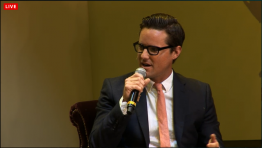
You guys remember Jason Russell, right?
It’s forgiveable, if you don’t. The dude kind of submerged from view after the WTF-worthy anticlimax following the viral fame of his KONY 2012 video. Statements were issued, catfights ensued, and the whole thing…
Well, did it fizzle out?
Let’s just say I had the kind of curiosity that a spectator at the Coliseum might have. Because when he took the stage at the Q conference, looking dapper as always in a navy blazer and pink tie, I expected some more swelling music and rallying rhetoric. Instead, he took a seat in one of the leather club chairs provided for the purpose, and proceeded with a Diane Sawyer-like interview with Q founder Gabe Lyons.
His first question to answer was, more or less, “How you been?” Hence, the quotation at the beginning of this post. Really, that was the first thing he said.
And I have to say that it set the tone for his entire “presentation”–humility sans groveling, candor without defensiveness.
There’s a clinical name for what happened to him, and he went to the hospital for it. He spent several days–maybe weeks, I forget–getting spoonfed and recovering from what was essentially a temporary schizophrenia. And after that, he took a low profile, let the organization he’d built do its own thing, and hung out with his wife and kids.
In the meantime, of course, there were rumors and nasty stories still flying. But his whole mission, at that point, was to keep his head down, so that they wouldn’t make him crazy again.
Human nature, he said, is to fix the wrong or negative perceptions, as quickly as possible. Or, if you can, to get ahead of them. It’s an impossible task. Trying to do that is crazymaking, as he found out.
Concerning KONY 2012 as a message, Jason went on to say something fairly compelling. He said the video was the result of him being angry at God, at having to make another movie about the plight of child soldiers, at the world for not paying attention. Which…I don’t know…seems like a normal missionary frustration, but complicated by artistic frustration. You want what you make to effect profound change, not only for the central cause that led you to make it, but also because the making process changes you so profoundly.
That’s a weird tension. And it might contain my whole personal beef with the way “storytelling” has become a touchstone for marketing in general and Christianity in particular. Whether he knew it or not, Jason expressed that mindset rather well:
That’s like my religion, is story. I think that was Jesus’ religion, too.

Several years ago, I worked as a nanny for a great family who were not great on discipline. One day, one of the kids lied to me and wouldn’t own up to something he’d done. So I waited on consequences until Dad got home. I told him what happened. He looked down at his kid and said, “[Name redacted], are you tellin’ a story?”
That’s where my head goes, whenever this “storytelling” line comes up. The thing with stories is that either they are meant to be taken as objective truth, or as representational truth. The audience needs to know that up front. Otherwise, the story is only a lie.
Taking a real issue, like child soldiery, and inflating it so that one man is the whole problem and taking him down will mean a reign of peace across eastern Africa…well, that’s the same as blithely asserting that the systemic sin in your church is just “part of a bigger story.” In both situations, an overemphasis on one truth is misrepresenting its companion truth. Context is everything.
Anyway, that’s what I think. (If you don’t like my lyrics, you can press fast-forward.)
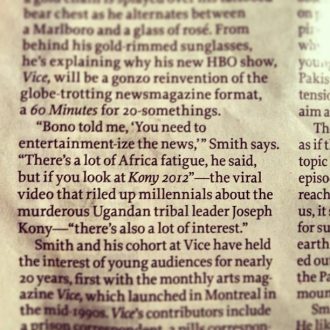
So this is all going through my head, as the music swells and the lights dim, and the newest venture from Invisible Children plays overhead.
Jason says that every compelling story has out a “broomstick”–it’s a Wizard of Oz analogy–the thing that has to be achieved to bring a good ending to the story. A good campaign holds the broomstick out to its audience, putting the Witch-killing power in their hands.
I totally agree–that’s gorgeous storytelling strategy. But the idea of a witch hunt makes me cringe. Especially one undertaken by the passionate underinformed. Especially one whose leaders profess “story” as their guiding principle, rather than the thing that their story is about.
Stories are powerful. You have to be careful with them.
So…what do YOU think about Jason Russell’s approach to storytelling? Holler at us.


