
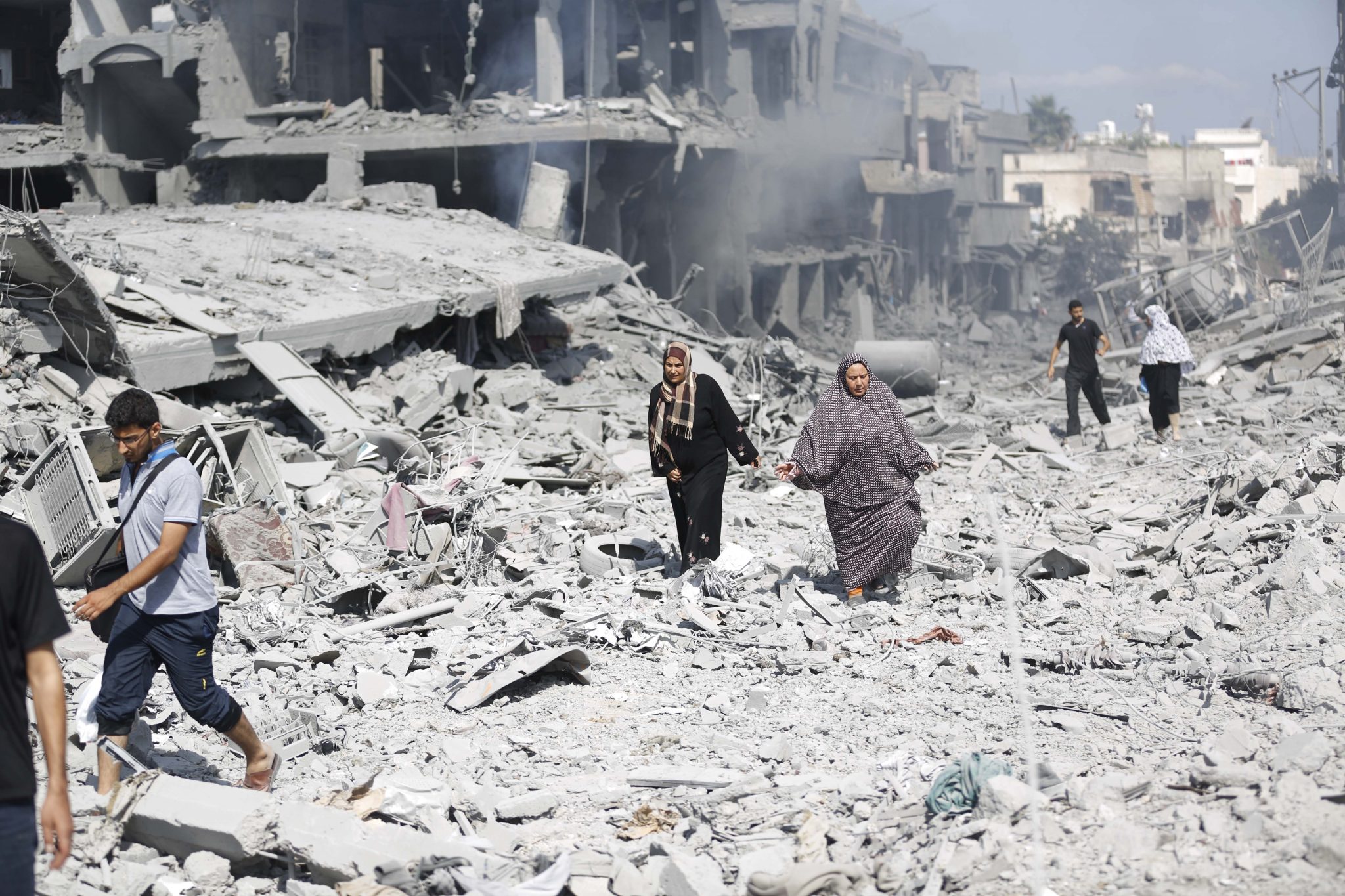
July, 2014 will forever be remembered as the time of one of the bloodiest conflicts in the history of the Gaza Strip. As Israel has flexed its military might, Gaza has endured unprecedented destruction; it is difficult to see how, once a lasting ceasefire is agreed upon, the area might carve out a new infrastructure that allows for freedom, growth, and opportunity.
Amidst the tragedy, there is a small community of Palestinian Christians in Gaza and the West Bank committed to seeking justice, peace, and hope.
Though many have left because of the stresses of the occupation, there remains a faithful few who believe their role is to be the catalysts for change, to advocate for a new paradigm where Israeli and Palestinian can live together.
I’ve been able to talk with members of the Palestinian Christian community in Gaza and the West Bank to hear their perspective on the conflict.

Rev. Dr. Yohanna Katanacho
Tell us about yourself and your ancestry.
I am Palestinian Israeli Arab Christian. My nationality is Palestinian and my citizenship is Israeli. 20 per cent of the citizens of Israel are Palestinian. My people speak Arabic as well as Hebrew. I am married to Dina whose Arab Christian family roots date back to the sixth century. What a blessing!
What does it mean for you to be a Palestinian Christian?
A Christian is a follower of Jesus Christ. I am simply His follower in a Palestinian context. Sometimes, my life seems as if I am Israel under Pharaoh, second class Gibeonite citizen, a murdered Naboth, and a weeping Jeremiah. It is depressing. Other times I feel like Ruth, Rahab, or one of Solomon’s wives. I am not allowed to be Aaron or Ezra because of impurities in my genealogy. I am not Jewish in a “Jewish State.” My best times are when I imagine myself a Paul, or a Peter, or even a Stephen sharing Jesus Christ.
How is the Palestinian Christian community responding to the crisis in Gaza?
We are weeping like Jesus who wept over Jerusalem. We lament with the book of Lamentations and mourn like the sisters of Lazarus. Sometimes we feel like Job in our prayers. Other times, we are praying the prayers of Jesus and Stephen — “forgive them” — and we assert that we are committed to loving both Palestinians and Jews. We pay condolences at funerals. We write essays encouraging people to seek peace, not war, love not hatred, justice, not oppression, equality not bigotry, peaceful solutions, not military solutions. We seek to spread a culture of love, peace, and justice in the face of violence, hatred, and oppression. We help the afflicted and plan for building a better future through education and other efforts.
How should the church reframe questions surrounding the land?
In a biblical worldview, all life is theological. I don’t want to think of land issues in isolation of theology. God is the creator of the land and Jesus Christ is its owner.
Several people use the word “Israel” to refer to biblical Israel as well as the state of Israel. Equating the modern state of Israel to Biblical Israel is a common error that prevents us from understanding the biblical text properly, and hinders us from advocating a fair solution to the Arab-Israeli conflict. In addition, insisting on equating biblical Israel with the state of Israel marginalizes the distinctions between the words Hebrew, Israel, and Jew. The terms “Israel,” “Jew,” and “Hebrew” are not identical. We cannot define Israel in a simplistic way that ignores its multiple meanings, social locations, and diversity in the genre of the text.
Describe the Kingdom of God, and what hope it gives you as a Palestinian Christian.
We can see the Sermon on the Mount as one of the best representations of the Kingdom of God. Jesus describes the blessed life as a life that hungers for justice and holiness (the first four beatitudes). We start with failure and hunger. Then we become agents of justice as we employ mercy and peacemaking for bringing about a world full of justice and holiness. This world needs people with transformed hearts. These hearts are without revenge, murder, and hatred. We advocate for a future rooted in creative nonviolent resistance to evil, love, and holiness. We seek to embody God’s agenda in building a future not on the sand of ethnocentricity, but on the rock of inclusive human dignity.
Rev. Dr. Hanna Massad
What is your background history of life and ministry in Gaza?
I was born and grew up in Gaza to a Greek Orthodox family, and got to know Jesus in a personal way through Gaza Baptist church, the only Evangelical church in the whole of the Gaza Strip. I went to Fuller Seminary in California, and earned my Master of Divinity degree and then later gained my Doctorate in theology. I had a sense that I was being called back to Gaza to serve the people there. I returned to pastor Gaza Baptist and joined the Faculty of Baptist Bible College teaching in their extension program until 2007.
My time in Gaza was not easy, and we experienced persecution and threats.
Could you describe what it is like for the Gazan people to live under blockades and military occupation?
The Israeli occupation has been very difficult to say the least. We experienced this difficulty at a very personal level a number of years ago. My wife and I were forcibly separated from each other for about nine months because Israel refused to give her a visa to come to Gaza. During this time she was in Jordan and I was in Gaza. We had to take our case to the Supreme Court in Jerusalem to bring her back to Gaza. During this time, my second child was born, and I was unable to see her for two weeks because of the siege.
What are the reports you are hearing from Gaza just now?
It is very, very bad. The war — we probably should not call it war because is not equal in terms of capability — in Gaza is the worst my people have endured. So many innocent women and children have been killed. Many houses are destroyed and so many are now homeless, seeking shelter in UN-run schools and refugee camps. There is now further threat from disease and malnutrition. So many Gazans are living in fear for what tomorrow might bring.
What would you encourage those in the West to do?
Gaza has been destroyed, and so many families are left with nothing. In spite of this, we can pray. Pray for the Palestinian people and join efforts to help the many people who are in need of food or medicine.

Sami Awad
Tell us about yourself and your family history.
I am the son of a Palestinian refugee from Jerusalem (on my father’s side) and a family from Gaza (on my mother’s side) having uncles, aunts and cousins who still live in Gaza until this day. My father was nine-years-old when the 1948 war broke out, his father was killed and the family was expelled from their home and became poor homeless refugees, mostly growing up in orphanages. The story of our family is the story of the legacy of my grandmother who, in all her suffering, always insisted that revenge and retaliation will never be an option to us. At the same time, we will not stand silent in the face of injustice, but will seek justice through working for peace and reconciliation with those who did this harm to us.
I was born in the U.S. in 1971, but since six months of age grew up in Bethlehem. Growing up under the iron fist of the Israeli military occupation was not easy. At age 12, I was introduced to nonviolence through my uncle Mubarak Awad who started the Palestinian Center for the Study of Nonviolence in Jerusalem. His deportation by the Israeli government in 1988 (claiming him as a threat to the national security of Israel) because of his nonviolence activism was the trigger for me to focus on learning and practicing nonviolence. I went to the U.S. towards the end of that year, did a BA in Political Science an MA in Peace and Conflict Resolution. I came back in 1996, and started Holy Land Trust in 1998.
You’ve committed your life towards nonviolent resistance. Why?
I saw it as the only tool to resist oppression and injustice that exposes the injustice and systematic oppression without harming those who are even leading it. At the same time, it creates no justification for them to continue their measures under pretense of threat. It is, as [Martin Luther] King said, the means to liberate the oppressor and the oppressed from the oppression.
What does it mean for you to be a nonviolent Palestinian Christian?
Being a Palestinian for me means to engage in nonviolence. Being a Christian for me means to have the spiritual roots for such engagement. It is not just about resisting, not only about exposing the injustice, but the deeper dimension of seeing all as created in God’s image. All need love, and all must be loved. It is connecting at a deeper human level of oneness.
How accepted is the nonviolent movement in the wider Palestinian context?
I believe that in theory, nonviolence is fully embraced and accepted. Very few criticize nonviolence from a purely rejectionist point of view. This said, I don’t believe that we have the deep roots in nonviolence that would allow us to engage in it fully. The main reason is the deep sense of resignation that exists in the community, and the feeling that nothing works. Even when violence is used, most believe it does not work for liberating, as much as it is perceived as “at least doing something.”
How do you seek restorative justice as opposed to retributive justice?
Our work is about peace and justice between communities, and a call for communities and individuals to take responsibility. It’s not just limited punishment of crimes. Restorative justice addresses the core causes of why violence has happened, and how to deal with it at its roots. It’s not just a reaction to the act of violence itself, it is about restoring the dignity and humanity of the victim and even the victimizer rather than just punishing one for the crime, and compensating the other for being violated.
What have been some of the breakthroughs you have seen in your work? What hope does that give you for the future?
Our work is slow and challenging, especially in a situation that has been in existence for so long, the new generation have no reference to anything before it. The work that needs to be done is like deep, complicated, and long surgery. Our success is not in quantity but in quality, working with a few over a long period of time, rather than working with many over short periods of time. [We are] healing traumas, developing leaders, and using nonviolence strategic thinking in both the Palestinian and Israeli communities.
Jesus calls us to love our enemies. What does this mean for you personally?
First, it is a commandment. There is no questioning of a commandment when you surrender your life to follow Jesus. You do not have the luxury to pick and chose what you want to follow and not follow. Second, it is about love, not negotiations, not resolving conflicts, not reaching an agreement. Jesus calls us to love, love means (just like in marriage) becoming one. When we are one, there is no enemy, there is no animosity. In a sense, what Jesus calls us to do is seek to live in oneness as human beings, even within the diversity we carry in us. Just like a union of two, the union becomes them while they are still two. It shows that all our differences, no matter what, are minor in our Creator’s eyes than our unity with each other and in Him.
Photo (Flickr CC) by Oxfam International.


