
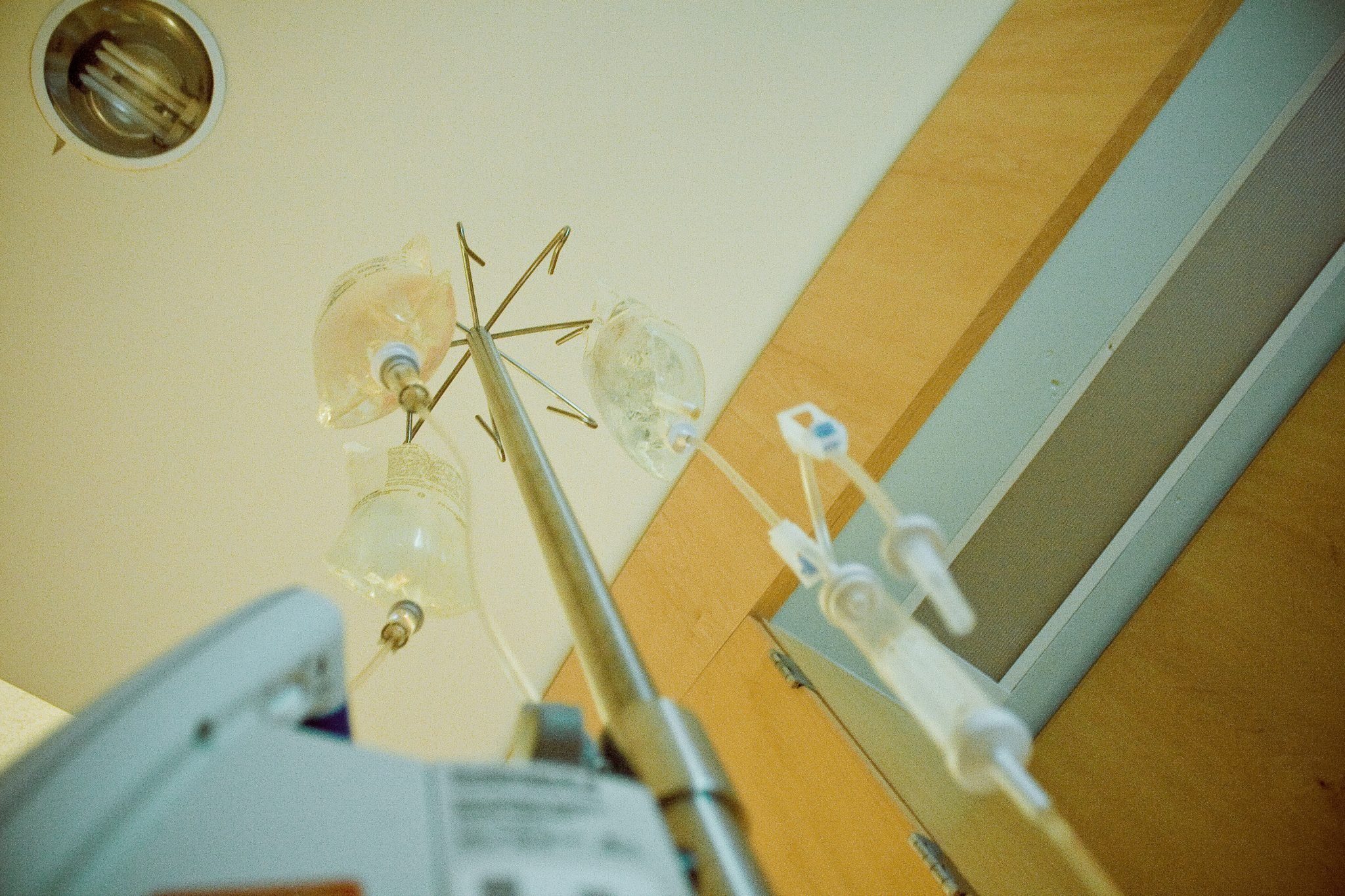
The outlook was bleak. As I lay hooked up to an IV in the city of Chongjin, I realized how much my mistake had cost me. I’d wasted all my money, lost my friends, abandoned my family, and turned my back on God. Now, at 23-years-old, I was going to die in North Korea.
Nurses buzzed about like bees in a hive. My head spinning, they rushed in and out of the small first-floor room just a stone’s throw from the Sea of Japan, or the East Sea of Korea as it’s known in North Korea.
I had no idea what was happening, which only made things more frightening.
Earlier that day, I woke up with the worst stomach cramps I had ever experienced. Next came the chills, so numbing I threw on my thickest jacket, a sweater, and two more shirts under that. It was summer. The headaches soon followed, which were beyond the very worst hangovers or a migraine. The diarrhea came last. Never-ending diarrhea.
Needless to say, it was quickly determined I should be rushed to the nearest medical facility, though I never heard an official diagnosis of my condition.
The saline fluids were trickling down a plastic tube and into my body with a viscosity so thick I could feel it coursing through my bloodstream. I was outright terrified. I had reasons to be.
To say North Korea is the most dangerous place in the world for Christians would be an understatement. Citizens are supposed to follow a state ideology known as “Juche,” which emphasizes atheism. Professing a faith in Jesus Christ can lead to one’s entire family being put in a prison camp, where they sometimes remain for the rest of their lives.
And prison sentences are just one potential punishment. In 2009, 33-year-old mother Ri Hyon Ok was reportedly killed after being accused of distributing Bibles. In March 2014, South Korean media claimed 33 Christians were executed for their connections to Korean Baptist missionary Kim Jung-wook and for receiving money to set up underground churches.
Even foreigners aren’t spared. Kenneth Bae, an American missionary and father of three, was sentenced to 15 years of hard labour for “crimes against the state” in May 2013. Among the evidence that helped secure his conviction was a Bible in his suitcase. He was released from prison Nov. 8 after a visit by U.S. National Intelligence Director James Clapper to Pyongyang.
[As with many reports regarding North Korea, the information cannot be independently verified. South Korean media have been known to exaggerate some stories about the North in the past, and it should be noted North Korea technically guarantees freedom of religion in its constitution.]

I may have been born into a Christian family, but I wasn’t exactly a regular follower of Christ. It had been years since I’d set foot in a church, and I was beginning to question whether the Bible was the only record of the Word of God. Still, I considered myself a “Christian” because of my upbringing in a Lutheran household.
And I wasn’t just a Christian, but I was also an American and a journalist — the things the North Korean government is said to despise most. I tried not to think what would happen if those facts came to light.
They hadn’t come to light so far, at least. Sneaking in with a group of six others, I was fortunate we had not encountered anyone who could read German, for if they did, they would know the worker’s permit in my passport listed my occupation as “journalist.”
My occupation was partially what had called me to North Korea. I’d wanted to make my mark in my field, to have an adventure in the most perilous place I could think of, and to come back with an incredible story. They were selfish reasons.
As I lay in my hospital bed, I tried to calm myself by breathing deeply. It wasn’t working. Even the hot towel massage the nurse kept applying to my throbbing head was having no effect. The IV tube was beginning to feel like fire where it entered my punctured right arm, a flashing pain akin to fireworks exploding under the skin.
I was sweating now. The room was stiflingly hot. Weren’t North Korean hospitals supposed to be freezing, lacking so much as basic medical supplies? The equipment here was modern, clean, and new.
But could even modern medicine save me? I’d realized something was wrong when I awoke with a massive hangover after a night of drinking so much I could only hazily remember what happened. Maybe this was God’s way of punishing me?
Darkness was creeping into my vision. The swirling was getting worse. I was running out of options.
Nothing else to do, I did something I hadn’t done in years: I prayed.
Dear God, I don’t know how you can, but please just get me out of this. Save me. Give me a second chance. Please. I beg you. I don’t want to die in North Korea. Let me live.
I opened my eyes. Nothing happened. The room looked the same as before. The medical staff were still milling about like flies.
For some reason my old confirmation verse sprung to mind. 1 Peter 5:10 (NIV) says:
“And the God of all grace, who called you to his eternal glory in Christ, after you have suffered a little while, will himself restore you and make you strong, firm and steadfast.”
Suffering? I was certainly suffering. Strong, firm, and steadfast? I definitely wasn’t feeling that at the moment.

Then it hit me. Doctors. In North Korea. Doing everything to take care of an American who was supposed to be their sworn enemy. They weren’t pumping me with cyanide, but injecting life-saving drugs, trying to make me strong again. They were my guardian angels.
Realization dawned. These people didn’t have to treat me, didn’t wake up knowing later that day they’d end up with perhaps the first Westerner they’d ever met in their care. After all, didn’t the propaganda constantly scream that all foreigners were devils? So why were they helping me?
The nurse kneaded her hands gently on the side of my head, relocating the pain that made my skull feel as if it were going to explode. The drip-drip of the IV resonated with an unnatural loudness.
Matthew 9:12-13 (NIV) says:
“On hearing this, Jesus said, ‘It is not the healthy who need a doctor, but the sick. But go and learn what this means: ‘I desire mercy, not sacrifice.’ For I have not come to call the righteous, but sinners.’”
My body would be taken care of by these people, but God would heal my soul. It was living proof that, when we least expect it, He is there for us when we need Him.
The revelation had lessened the pain in ways even the most advanced medicine never could. Maybe I wasn’t as lost as I thought I was. Maybe — just maybe — there was hope after all.
Featured photo (Flickr CC) by Allan Foster.
Secondary photos by Benjamin Mack.


